An offense!

Breaking traffic rules is an ‘offense‘, a breach of law or an illegal act, how many drivers realise this? Traffic rules have been designed to bring order on roads and to facilitate safe and smooth movement of vehicles, but with largely poor quality education and training for learner drivers, low literacy amongst many drivers, shamefully low fines for traffic rules violations (as low as $3), corruption, poor policing and absence of any mechanism to imprison repeat offenders, the roads of India have become a haven for traffic offenders. The people of India need to be made aware that breaking traffic rules is an offense and those caught need to be treated sternly (like offenders), fined heavily and even jailed at least for a few days if not weeks (for offenses like driving on the wrong side of road). One way to look at India’s alarming road safety situation (the country has the worst rate of road accident mortality in the world, more than 1,00,000 people die on India’s roads every year) is that such a scenario exists because thousands of traffic ‘offenders’ roam around freely on India’s roads with little or no fear of the law.
Wasteful use of electricity

Electricity is in short supply in India, millions here, specially in rural areas, don’t have access to regular electricity and yet it is not hard to find mismanagement or wasteful use of electricity in Indian cities, an irony that this graphic tries to convey. Many commercial centers and markets are ostentatiously lit up in urban India; during Diwali festival, buildings are profusely lit up and lighting decoration contests are held in some cities; government buildings and landmarks are sometimes lit up all night! What if electricity is used judiciously, electronic displays and Diwali decorations are put up with restraint and the electricity thus saved is diverted to rural areas?
Corruption takes away from development

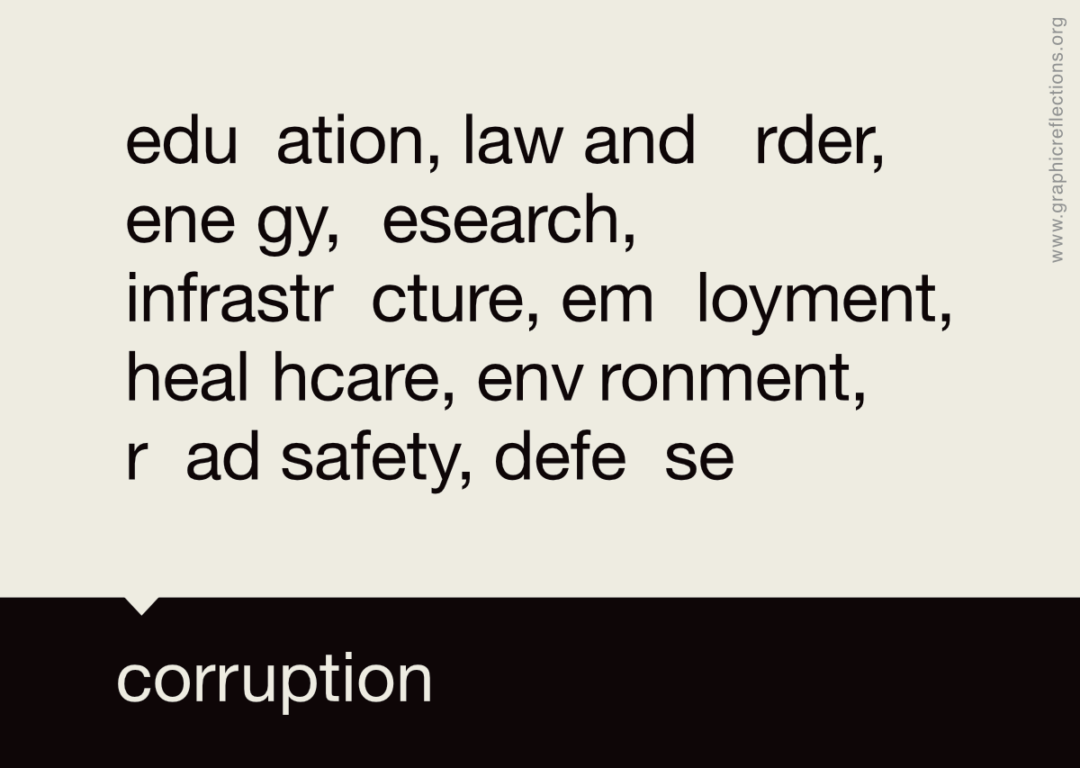
Rampant corruption, like the kind that exists in a developing country like India, takes away from every aspect of the development process. To illustrate this point, in the typographical graphic above, one letter has been taken away from each set of words related to development and used to compose the word ‘corruption’ below. Though efforts are made to hide corruption by those who indulge in it, it does show up eventually, often through incomplete or less effective or shoddy development that results from corruption (as shown in the graphic).
Happiness

Happiness, is it inside me or outside? Do external factors like behaviour of others or the living environment make me happy or is happiness internal and all about how I deal with the external factors, some of which are beyond my control?
Corruption

Corruption, that puts interests of the self (or the corrupt) before the larger interests of the nation, in myriad ways big or small, ends up breaking the fabric of the nation.
Alive!

A heart beat perhaps best describes being alive and if you look at its visual representation closely (or symbolically), being alive means facing or experiencing the continuous ups and downs of life
Rainwater collection scenarios in urban India

The information graphic above looks at a typical Indian city from the perspective of (rain) water availability and depicts four scenarios: 1. The current or past scenario wherein rainwater falling over a limited area collected in nearby lake/s is distributed to the city. Here, water for the entire city is essentially accumulated at one location. 2. An ideal scenario wherein rainwater collection is widespread and each property collects rainwater for domestic use and enough water is also collected in nearby lake/s. So rainwater falling over a much wider area is utilised. 3. This scenario depicts the foolish and alarming reality of today and tomorrow, wherein owing to erratic rainfall, increase in demand and destruction of catchment areas, enough water is not collected in lake/s that supply municipal water, city dwellers ignore precious rainwater and let it go waste, depending instead on sub-standard water pumped out of deep bore wells. Many are forced to buy expensive water the quality of which can be questionable. 4. This scenario depicts what city dwellers should be doing or what they will ultimately be forced to do, wherein almost all properties (spread over a much larger area) collect rainwater, use it for domestic purposes and ease off pressure on already stressed lakes and groundwater reserves, which could also be recharged by channeling excess rainwater back into the ground.
If you are one of those rare Indian city dwellers who collect rainwater in your property, then you will probably know just how much water a single rooftop can collect from just one day’s good rain, often it can be judiciously used for months! If you are not one of them, it’s time you at least started thinking about it! Usually, a rainwater collection system costs less than a deep bore well and in terms of water quality, there can be no comparison to rainwater!
Development and water

This graphic attempts to illustrate the correlation between the urban development process in India and falling availability of water, groundwater in particular. Construction of buildings and infrastructure (which is currently happening at a fast rate in India) requires heavy use of water, most of which is pumped out of the ground. Water is then used intensively by people who reside / work in the buildings with little or no attempt to recharge the groundwater or to harvest or store rainwater. Moreover, nearby lakes or ponds that are some of the most efficient means of recharging groundwater, are filled up and the ‘new’ land used for more buildings. Once the groundwater depletes or becomes unfit for consumption, many residents are forced to leave and those who stay have to buy expensive commercial water and in many cases the value and usefulness of the ‘developed’ properties declines. If you look at the current urban development trend in India from the perspective of water (the liquid critical for sustenance of life), that it is about short-term gains and long-term loss is not difficult to see..
Life span of a littered PET bottle

This graphic attempts to illustrate the life span of a littered PET bottle, as inspired by the shape of the bottle itself. With a substantial time spent in production, shipping and shelf display, its usage time is usually the shortest, often just a few minutes and if not disposed properly (like this one which I found in the midst of vegetation at Central Park, Jaipur, India), it can lie for months, sometimes years, as nothing but waste…
Wall versus rock

These photographs were taken a couple of years ago in the city of Jaipur (Rajasthan), India. The one on the left is of a thick stone wall from Jaipur’s historic walled city (also known as the Pink City). The one on the right is of a conglomerate rock located inside a city park. One major difference between these two is of age, the wall is less than 300 years old whereas the rock is estimated to be about 1600 million years old (yes!). Many (man-made) walls and structures in the historic Jaipur walled city are in a state of decay, some have crumbled, yet the rocks in the nearby Aravalli hills look as good as new! Isn’t nature’s ability to ‘maintain’ itself amazing?